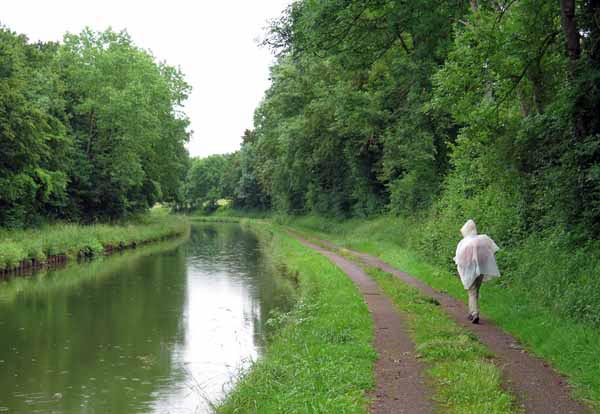
The Canal du Nivernais, begun in 1784 and opened in 1842, links the Loire with the Seine, as does the earlier Canal de Briare (opened 1642).
Its northern part follows closely beside the Yonne river and was originally built, not for boats, but to allow the floating of timber from the forests of the Morvan to the factories and fireplaces of Paris. The river itself was unreliable for this purpose until downstream of Auxerre, which is where the canal ceases.
In the southern section, getting the canal over the steep watershed was a difficult engineering feat, involving a veritable ladder of locks, along a feeder channel from the Yonne and even some tunnels.
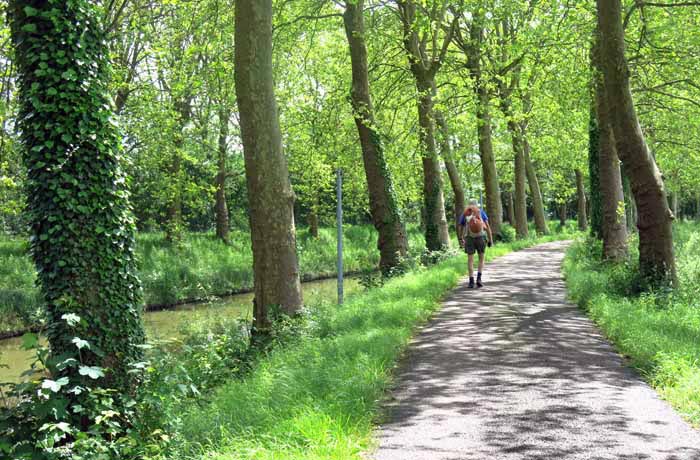
When it was finally connected to the Loire, the canal proved useful for other sorts of cargo – stone, grain, wheat and wine – and helped greatly in the economic development of the area. Horse-drawn canal barges were used for this trade.
It was difficult to reconcile barge traffic with great unruly rafts of logs using the same canal, but it was not this that killed the canal trade – it was, as usual, the arrival of the railways. It is now used only by pleasure boats, and of course by cyclists and walkers.
The account of this walk has been broken up into two sections, separated by ten years:
We think that the first of these sections, from Auxerre to Clamecy, is an ideal introduction to walking in France. The path is flat, the scenery is beautiful, the villages are not far apart and there is an SNCF train station at each end of the walk.
To see icons for each night’s accommodation on this map, press the full-screen symbol at the top right and then tick the accommodation icon box at the top left. Zoom in on a particular icon to see its precise location. These accommodation icons are also shown on all section maps.
You can also see this map using Google Earth and take a virtual flight along our route.